Mount Dora Mornings: Finding God in the Ordinary
Hello, Praying Friend!
The road has a particular seduction, and after thirty-plus years of airports, green rooms, and hotel breakfast bars that all look exactly the same, I know it well. There’s a ritual to loading the car, running the checklist, pulling out of the driveway while the house disappears in the rearview mirror — and something in you exhales, not because you’re relieved to leave, but because the road is familiar.
I’ll confess something that I find mildly embarrassing: the smell of a rental car comforts me. That particular new-plastic, climate-controlled, anonymous smell. It’s disconcerting how much I love it, because it means I’ve spent so much of my adult life in one that the smell of a strange new car feels familiar, like an old, comfy chair. For most of my career, that smell was (and still is, I guess) the smell of purpose.
I am learning — slowly, not without some resistance — that I had that exactly backward.
Mount Dora, Florida, is a town that doesn’t try very hard to impress you, and somehow impresses you anyway. A quaint, unhurried place in the heart of hilly Lake County that carries the atmosphere of a small New England town, except the oaks are covered with Spanish moss and the light on the water changes hour by hour, and if you take a few minutes of that hour to notice, it can be profoundly spiritual. For a long time, this place was a best-kept Florida secret. It is less of a secret now, which is both a blessing and a minor grief, depending on the weekend and who you ask.
Five years ago, there was only one place downtown where you could get great coffee. Now there are six.
More mornings than not, I end up at the Deli Lama — and the name alone should tell you something about it. Great coffee, unusual, unique, and great food, and Sunshine (that’s her name) behind the counter or somewhere nearby. Sunshine used to go to church. We’ve talked about that a few times, not in any directed or strategic way, just the way Christ has guided our conversations. She hasn’t said much, and I haven’t pushed. But I’ve learned that leaving the door to a conversation open is important. Sometimes an open door is what lets someone else in, too.
Then there’s Cody’s on 4th, where the team waves at me when I walk in, or even past the windows, zig-zagging through the lovely Parisian-style outside seating. It’s not just the staff trained to make customers feel welcome, but a real wave, the kind that means we know you. Cody was in Las Vegas a couple of weeks back and caught a magic show, texting me from the audience to ask if I knew the performer. As a matter of fact, I did — we competed against each other when we were sixteen years old. (That’s the thing about a small town and a life lived long enough in one place. The world turns out to be embarrassingly small, and that smallness, which you once might have mistaken for a limitation, reveals itself over time as something closer to a beautiful gift.)
There is a man I’ve gotten to know over the last few years through these kinds of unhurried encounters — conversations that drift from nothing in particular to something real, the way they do when you give them enough time and neither person is trying to get somewhere. He doesn’t fit any category you’d expect to find in an essay about morning coffee and the presence of God. His vocabulary runs very colorful, his appearance suggests a set of life experiences considerably different from mine, and for a long time, our conversations stayed comfortably on the surface, which was fine. Then, a few months ago, he opened up to me in ways I found genuinely startling — heavy, personal things, offered carefully, the way people do when they’ve been carrying something alone for a while. And then, almost as an aside, the way people say the truest things quickly and sideways, he asked me to let him know the next time I was preaching. So he could come.
I’ve been thinking about that for a long time.
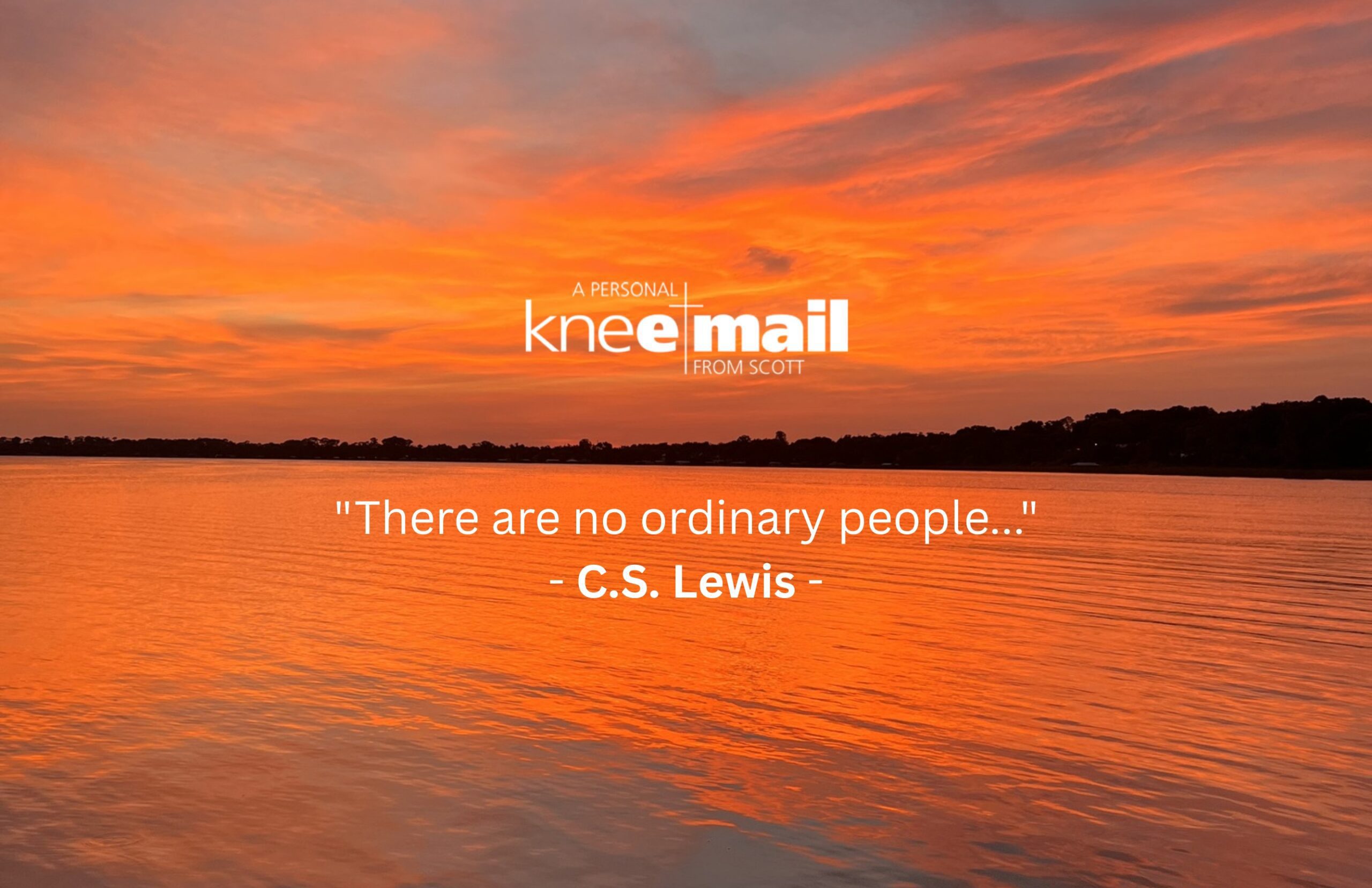
C.S. Lewis, in The Weight of Glory, wrote that it is a serious thing to live in a society of possible gods and goddesses — that the dullest, most uninteresting person you might talk to today could one day be a creature so glorious you’d want to fall to your knees before them, or else a darkness you’d only recognize from nightmares. “There are no ordinary people,” Lewis concluded. “You have never talked to a mere mortal.” I used to read that passage as a call to treat strangers well, a kind of elevated reminder about human dignity. I think it’s something more specific than that now. It’s an argument for staying put long enough to find out who someone actually is.
(BTW, I have invited my friend; he couldn’t make it that day, and when I am up again in the pulpit on a Sunday, I’ll extend another invite.)
Mostly, the road doesn’t give you that. The road gives you one night, one show, one green room conversation that ends when the gear gets loaded. The road has its own grace — I’ve watched wonder break open in rooms full of strangers, and I will never stop being grateful for that. But the road also flatters a certain way of moving through the world, always arriving somewhere new, always the person who just came from somewhere else, never quite rooted enough to be known well.
Mount Dora is showing me something different. It’s teaching me that being known is not a compromise of the calling — it’s an extension of it. That the same God who works in the large room with the lighting rig and the audience and the moment of communal astonishment also works at the small table and the coffee cup and the man who surprises you on a Tuesday morning with something he’s never told anyone. I believe these are not two different categories of experience separated by magnitude, one sacred and one ordinary, but the same experience rooted in Christ, wonder, and imagination, but wearing different clothes.
Six coffee shops where there was once one. A neighbor who asks about your schedule. A continuing conversation with a lady named Sunshine that is incomplete. A text from a Vegas showroom that connects me back to a sixteen-year-old version of myself, which I’d almost forgotten. These are what I call breakfast moments — moments small enough to miss and large enough to change you, moments you can talk to God about over the morning cup because He was already there, and you almost walked past Him on your way to somewhere else.
I am still learning to love being home. Still learning that my town is remarkable not in spite of its simplicity but through it — in its people, its unhurried rhythms, the particular way the light hits the lake on a morning or an unreal evening Sunset. The rental car still smells good to me. I don’t think that’s changing anytime soon. But I’m beginning to understand that a mundane Monday in a town that knows your name might be the thing I was looking for on all those long roads between somewhere and somewhere else.
Leading With Imagination,